Something went Wrong
Try entering your email again or contact us at support@qfi.org
Try entering your email again or contact us at support@qfi.org
You’ll receive an email with a confirmation link soon.
Mar 1, 2026
The QFI Year 7 Arabic Study Plan is designed for complete beginners with little to no prior knowledge of Arabic. The Year 8 and Year 9 Study Plans build on this foundation and are tailored for students returning after one or two years of study.
Together, these plans aim to develop and nurture students’ understanding of the Arabic language and culture and support their progression in their early stages of learning. Each Study Plan consists of two parts:
In designing these schemes, we have taken into consideration educational principles as well as the purpose of the curriculum. We have considered several key questions:
As a result, the schemes are in line with the 2016 MFL Pedagogy Review report conducted by the Teaching Schools Council. They provide a solid foundation for a learner embarking upon a course of study that will lead to the Arabic General Certificate of Secondary Education (GCSE).
Each plan is designed to cover a course of learning that involves two to three lessons per week over an entire school year. If less time is allocated to Arabic, the course will take longer to deliver and may even run over two years. At the same time, the schemes do not need to be limited to learners embarking upon a study of Arabic from Year 7, 8, or 9, but can be adapted to suit students starting Arabic in later years.
Content: language and culture
As well as teaching language in the sense of grammar, vocabulary, and skills, the schemes also seek to widen students’ knowledge of the culture and history of countries where Arabic is spoken. We recommend that rather than simply presenting culture as a series of discreet facts, learners should be encouraged to actively participate in communicating with Arabic speakers and experience and discover the culture out of an inherent curiosity. So, just as important as learning to notice and investigate linguistic phenomena, learners should also be noticing, investigating, and interacting with Arab culture. To this purpose, we have included in the intercultural awareness column a range of possibilities and suggestions for exploring aspects of the cultures of the Arab world.
We recommend that each lesson contains a variety of elements: some language, some culture, some script, and review and recycling.
Target language
The target language, Arabic, should be used as much as possible in the classroom. The goal should be communication, and learners should use the language in every lesson. Activities such as roleplays and information gaps can be used to get students to use the language, both listening and speaking to one another.
Teachers should set the example by giving instructions in Arabic and encouraging students to use the Arabic language spontaneously, such as teaching students’ basic classroom language to answer the register, check the day and the date, or ask for things. Routines, where students use Arabic in these ways, can quickly be established and reinforced with a classroom language sheet stuck at the back of the exercise book or a display on the classroom wall. QFI’s Chatty Mat for Arabic contains a range of useful phrases and vocabulary to encourage use of the target language in the classroom.
Teachers should also feel free to use some basic Arabic grammatical terminology from the beginning; just as you might expect your students to use English terms like nouns or verbs, learners should be comfortable with the equivalent Arabic terms.
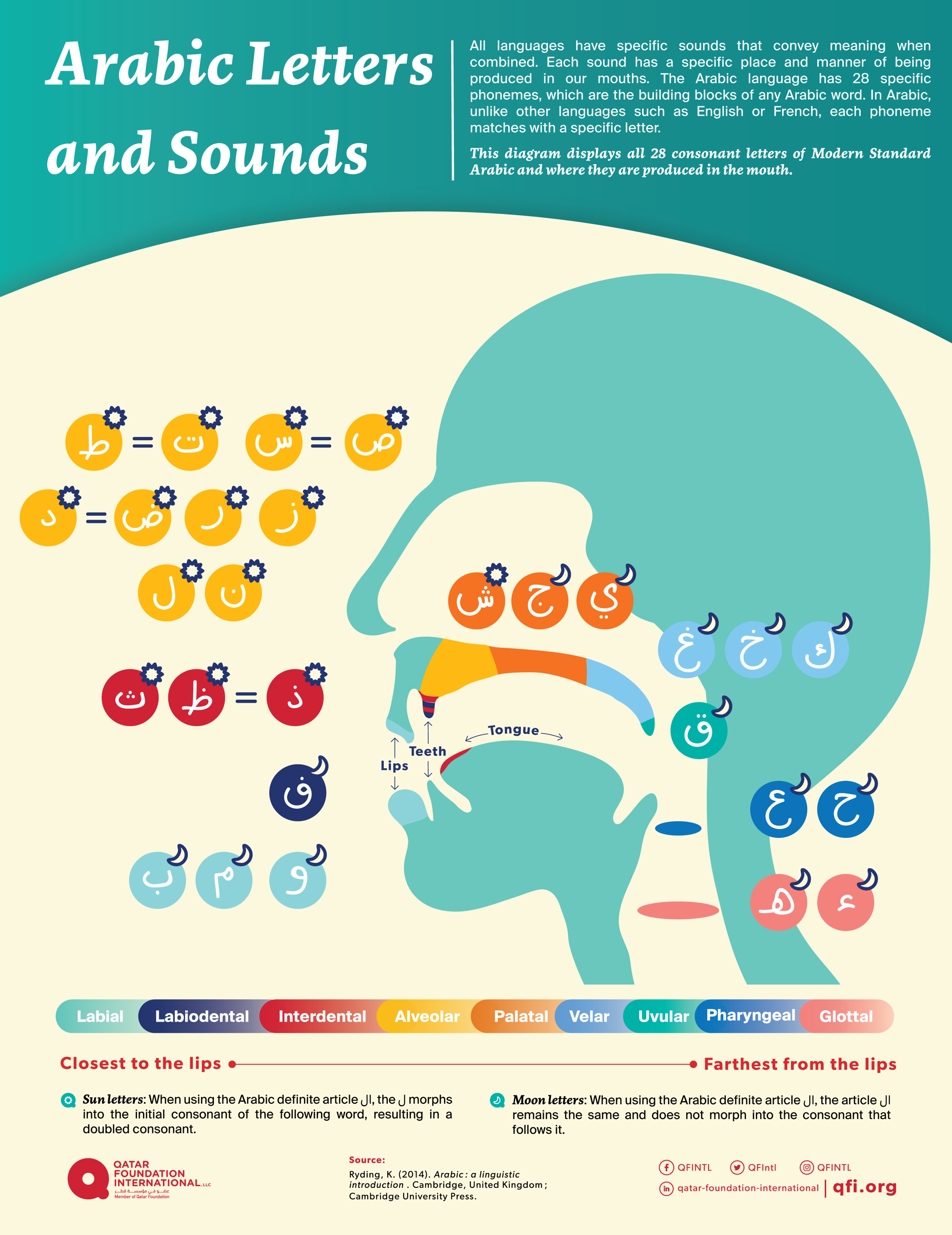
The Arabic letters: shape and sound
Since some Arabic sounds are non-existent in English, students should be explicitly taught the pronunciation of each Arabic letter in the first term. In these Study Plans, the teaching of the letters follows the pattern of pronunciation: the order begins with the letters pronounced by the lips and ends with the deepest letters in the throat. Teachers may prefer to introduce the letters in a different order based on what they feel is most useful and relevant to their classroom’s learners.
Each letter can be associated with a noun; this could be of a school object, an animal, fruit, or vegetable. Teachers should feel free to use words they think are most relevant to their learners. As students learn the letters, they can also be taught to merge them with short and long vowels.
A range of phonics-based resources are available online for teaching these early stages of Arabic literacy.
Transliteration
It will take a long time for a complete beginner of Arabic to master the script and achieve the spontaneity of recognition that they enjoy in the alphabet of their mother tongue. For this reason, the teacher can employ a system of transliteration that allows learners to record and read Arabic words using letters from the English alphabet and some other symbols to represent sounds that exist in Arabic but not in English such as the numeral 3 to represent the Arabic letter ع. There are many different transliteration systems available that are used in textbooks and dictionaries. The most important thing when using transliteration is that the system should be consistent and use the same specific English letter (or combination of letters) for each Arabic letter. Students must be taught the transliteration system, shown how to use it, and realize that it is a way to represent Arabic pronunciation.
In many classes, the teacher may have learners who have some familiarity with the Arabic script and others who do not. They will need to be flexible in the use of Arabic script and transliteration.
There is general agreement among Arabic language educators that once learners have encountered the Arabic letters and had opportunity to become familiar with them they should be "weaned off" transliteration. The timing of this will vary depending on the number of classroom hours and the frequency of class sessions. Learners who have 45 minutes to an hour of class for five days a week will be able to more quickly learn the alphabet and transition away from the use of transliteration in the classroom.
Assessment
There are many ways to assess your learners, and we leave it to individual teachers and schools to follow their own policies on this. We have included regular opportunities for review and assessment. Teachers can assess students’ performance throughout the term using various techniques, including quizzes and set language activities. Students should also be encouraged to compile portfolios containing their favorite pieces and to work in groups on projects and presentations that can also be used for assessment purposes.
Resources
A wide range of resources are available in book form and online. We have suggested some core and supplementary resources you can use, with a range of language-based games to bring Arabic language learning to life in a fun and varied way.
The Study Plans also reference digital resources. There are some great related websites that allow students to complete exercises at their own pace and practice the work completed in class independently.
Year 7 Scheme of Work
Year 8 Scheme of Work
Year 9 Scheme of Work